The first week of Lou Bertillon's tomato year begins on a Tuesday in late August, when she walks ten blocks from her apartment in Carroll Gardens to a small Italian grocery on Court Street called DiPalo Brothers — no relation, she will clarify, to the more famous DiPalo's on Mott — and buys a flat of San Marzano tomatoes for thirty-eight dollars.
The flat weighs about fifteen pounds. She carries it home in both arms, balancing the box against her chest, and sets it on the kitchen counter to ripen for another two days.
By Thursday morning the tomatoes have gone slightly soft at the shoulders. They smell like a greenhouse. She begins.
She has been doing this since 2014, when a friend in Westchester gave her a Nesco American Harvest dehydrator that had sat in a closet for a decade. The dehydrator is loud and ugly and runs on the back porch off an extension cord. It is one of her favourite kitchen objects.
She halves each tomato lengthwise with a small serrated paring knife. She does not seed them. Some recipes call for scooping out the gel, and she has tried it both ways, and she has come to believe the seeds add complexity to the finished tomato. They also dry to a slightly chewier texture, which she prefers.
She lays the halves cut side up on the dehydrator trays. She salts them with Maldon — a flake about the size of a fingernail clipping on each half — and grinds a single twist of black pepper across the whole tray.
She does not add herbs at this stage. Herbs go in later, when the tomatoes are jarred. Dried herbs in the dehydrator scorch.
Four trays fit the dehydrator. She loads roughly seven pounds of tomatoes at a time, which means the fifteen-pound flat takes two runs. She starts the first run at 9 a.m. Thursday and the second on Friday morning.
The dehydrator runs at 135 degrees Fahrenheit for fourteen hours. She has tried 125 — the manual's recommendation for tomatoes — and finds it gives a softer, more moist result that does not store as well. At 135 the tomatoes go a deep brick red and become leathery rather than crisp.
Crisp is too far. The texture she wants is somewhere between a dried apricot and a piece of soft leather. They should bend without breaking. If they snap, she has overdone it.
During the dehydrator's fourteen hours she writes magazine articles in the next room. The unit hums through the open window. The apartment smells faintly of tomato all day.
At eleven o'clock that night she lifts the trays out one by one. The kitchen is hot from the dehydrator's exhaust. She inspects each tomato by hand. The thinnest at the edges are sometimes done early; she pulls those off and lets the larger ones go another hour.
By midnight the first batch is finished.
She lets the tomatoes cool on a rack overnight on the counter. In the morning they have firmed up further. They have lost about ninety percent of their original water weight. A pound of fresh tomato yields, roughly, an ounce and a half of dried tomato. The math is humbling, every August.
The second batch goes through Friday into Saturday morning. By Saturday at noon she has the full year's supply on the counter — perhaps twenty ounces of dried tomato in total, spread across two baking sheets.
She jars half of them dry, in a quart Mason with a tight lid, for use in winter stews and pasta. These will keep, she has found, for about eight months in the back of the cupboard before they begin to lose flavour. She has eaten them at ten months and survived, but the third bite is never as good as the first.
The other half she packs in olive oil.
The oil-packed jars are the indulgence. She uses a Sicilian extra-virgin from a small importer in Red Hook that costs her thirty-two dollars a litre. She layers the tomatoes into half-pint jars with a few leaves of fresh oregano, two cloves of garlic split lengthwise, and a strip of lemon zest. She covers everything with oil and presses the tomatoes down with the back of a spoon to release any trapped air.
She stores the oil jars in the refrigerator. They are ready to eat after a week and best after three.
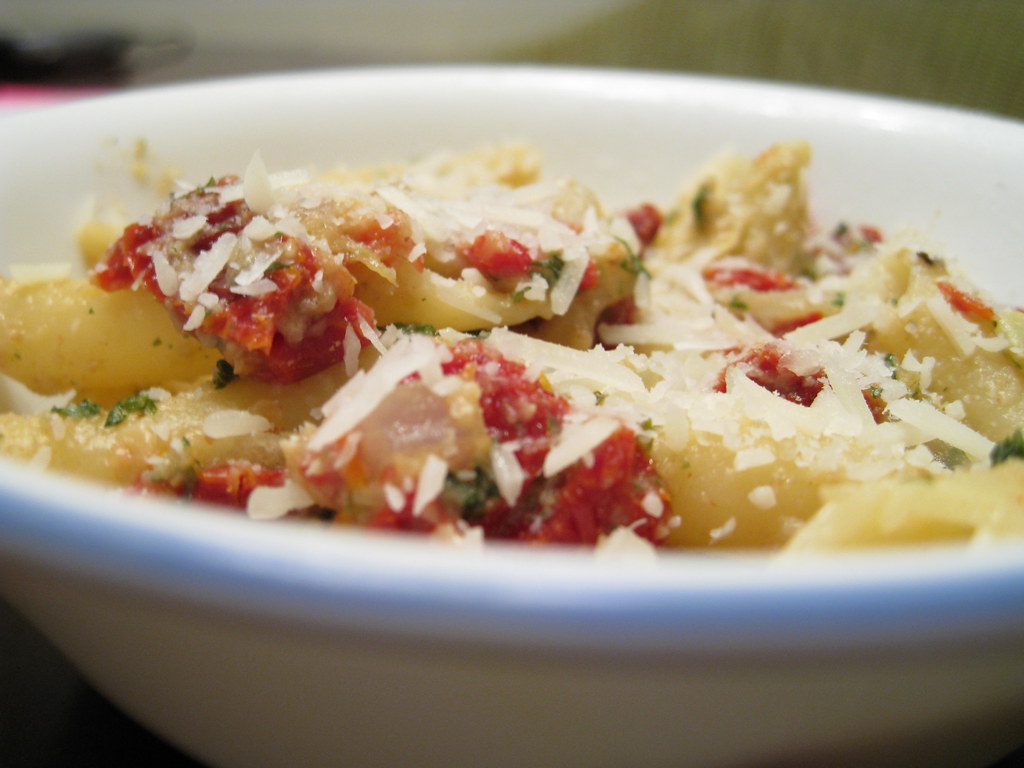
From September through March they appear on toast, in pasta with anchovies and capers, on top of soft scrambled eggs, alongside a slice of grilled bread and a glass of cheap red wine on a Wednesday night when she does not feel like cooking.
In April the last jar is finished. She rinses it, lets it dry on the rack, and puts it back in the cupboard with the others. She does not buy sun-dried tomatoes from the store. She has tried, more than once, in the lean months, and has come back disappointed each time.
It is, she thinks, the simplest preserving project a city cook can undertake. The dehydrator was free. The tomatoes are a once-a-year expense. The labour is two evenings of inattention while the machine runs on the porch and the apartment smells, faintly and persistently, like the end of summer.