Adrian Coate keeps a five-pound paper sack of Royal Corona beans, bought in February from a small importer in Bend, on the second shelf of his pantry in Portland.
Once or twice a month he soaks a pound of them in cold water in the late afternoon and starts cooking them at eight in the evening, in a heavy cast-iron pot he found at an estate sale in Beaverton for thirty-five dollars in 2011.
The pot goes on the smallest burner of his ancient O'Keefe and Merritt stove, set to the lowest setting it can manage without going out, which after forty years of service is a setting only Coate fully understands.
By eight thirty the beans are barely murmuring, three or four bubbles a minute, the surface of the water trembling rather than rolling.
He adds an onion, halved through the root; six cloves of garlic, peeled but whole; a single bay leaf from a tree on his sister's patio in Ashland; and a glug of olive oil from a tin a former student of his sends every December.
No salt yet. Salt goes in at the end, which is one of the few hills Coate is willing to die on in the long civil war between bean cooks.
He goes to bed at ten thirty and trusts the pot.
The first time he did this, in 2009, he did not trust the pot, and he set an alarm for one in the morning to check on it. The beans were fine. He has not set an alarm since.
By six the next morning the beans are tender enough to crush against the roof of the mouth, the broth is a pale gold, the kitchen smells like the kitchen of someone who has been cooking for a long time, and the pot is still warm.
He turns off the burner, salts the broth heavily, and lets the beans sit in their liquid for another forty minutes while he makes coffee and reads the paper.
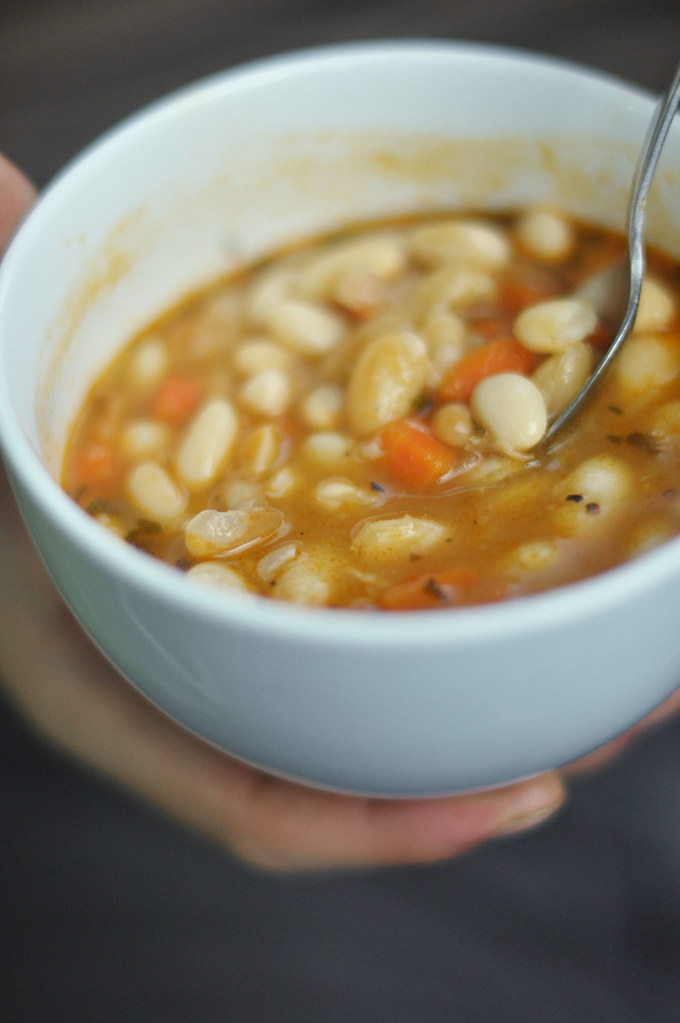
The yield is roughly five cups of cooked beans and four cups of broth, which is enough for the week.
Coate eats them in three or four ways, none of them complicated. On toast with olive oil and lemon. Stirred into a pan of greens. With a fried egg and a great deal of black pepper. Cold, with vinegar and red onion, the next afternoon.
He does not blend them. He does not turn them into soup. He has spent the better part of two decades resisting the cultural pressure to convert beans into other things.
The broth is, in his estimation, the better half of the project. He drinks a cup of it warm at his desk, the way other people drink miso, and he uses the rest as the base of a Tuesday risotto.
Royal Coronas are large, flat, white, and faintly nutty. Coate has tried thirty-odd bean varieties over the years and keeps returning to them because they hold their shape across a long cook and because the broth they produce is exceptional.
He has also cooked, with success, the Marcella beans from Rancho Gordo, the cranberry beans from a farmer at the Hollywood Farmers Market named Iris Wexler, and a small mottled bean from a Greek importer that he can no longer find.
He does not cook chickpeas this way. Chickpeas, in his view, want a different rhythm.
The most important variable, he says, is the pot. A thin pot will scorch on the bottom long before the beans are tender. A thick pot, on a low burner, will not.
He inherited the principle from his grandmother in Wilsonville, who cooked navy beans in a cast-iron pot every Saturday night of her adult life, and from whom he also inherited the pot's smaller cousin and the bay tree, before it migrated to Ashland.
Coate does not romanticise this. The beans are good. They are not transformative. They are dinner for most of a week, made for under three dollars in dry weight, in a pot that has paid for itself many times over.
What the overnight method gives him, more than anything, is the absence of vigilance. The beans cook while he sleeps, and he wakes to a finished thing.
Some Saturdays, when he has the time, he starts a second pot the same evening, with a different bean, just to compare. He keeps a small notebook of the results. The current entry, from May, reads only: Coronas again. Still the answer.