On the first Friday in April, in a kitchen in Toronto's Riverdale neighbourhood, Rosa Whittaker took a packet of instant yeast out of the freezer at half past four in the afternoon.
Her sister Daniela was coming for dinner at seven, with Daniela's partner Mauricio, who eats more bread than anyone Rosa has ever known and is unembarrassed about it.
The rolls she makes on these evenings are not impressive. They are not sourdough. They will not photograph well. They are a quick yeast roll, made in one bowl, with the kind of soft pillowy crumb that holds butter and absorbs gravy and disappears off a plate in three bites.
The recipe came originally from her grandmother's church cookbook, a spiral-bound 1979 production from a parish in Hamilton, Ontario, where her grandmother kept it under the breadbox until her death in 2011. Rosa has the original. She has not opened it in years. The recipe lives in her hands now.
Three and a half cups of all-purpose flour, two tablespoons of sugar, a teaspoon and a half of fine salt, two and a quarter teaspoons of instant yeast — one of those small foil packets she stocks in the freezer door, six at a time, replaced when she remembers.
She mixes the dry ingredients in a large bowl with a fork. Then she warms a cup and a quarter of whole milk and a quarter cup of water together on the stove until the mixture is warm to the back of her finger and no warmer. She melts three tablespoons of butter in with it.
The wet goes into the dry. An egg is cracked in. She mixes with a wooden spoon until it comes together, then turns it out onto the counter and kneads for about four minutes, just until the dough is smooth and elastic and not quite tacky.
The first rise is forty-five minutes, covered with a clean tea towel, on top of the gas stove with the oven preheating below it. The dough rises briskly in that warmth.
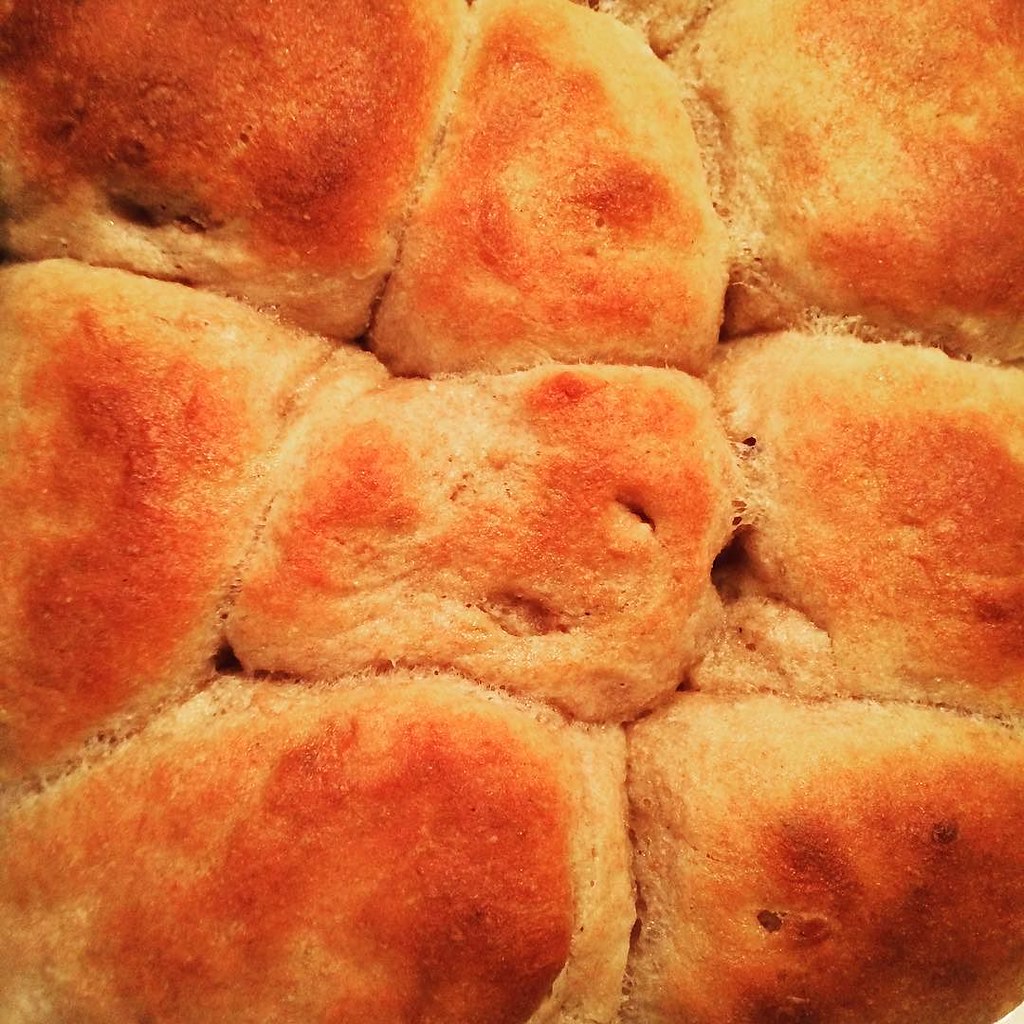
At a quarter past five, she punches the dough down and divides it into twelve roughly equal pieces, eyeballed, never weighed. She rolls each into a ball between her palms and arranges them in a buttered 9-by-13 pan, three across and four down, so that they will touch each other as they rise and bake into the soft tear-apart cluster her sister has loved since she was eight years old.
The second rise is twenty-five minutes. The oven is at 375 degrees Fahrenheit. She brushes the tops of the rolls with a beaten egg and a splash of water before they go in.
They bake for nineteen to twenty-two minutes. She pulls them when the tops are deeply golden and the kitchen smells like a bakery she went to once in Saint-Henri.
While the rolls are baking she makes the rest of the dinner. Tonight it is a roast chicken that has been in the oven since 5:15, started on a bed of carrots and onions and finished with a drizzle of the pan juices over the bird at the end. There is a green salad with a sharp mustard dressing. There is a bottle of inexpensive Beaujolais on the counter, breathing.
Daniela and Mauricio arrive at seven on the dot. They always do. Mauricio walks in, takes off his coat, washes his hands at the kitchen sink, and stations himself near the rolls.
Rosa pulls the rolls from the pan to a cloth-lined basket. She brushes the tops with a little more melted butter. She sets them on the table next to a small dish of softened butter with flaky salt scattered over it.
Mauricio eats three before the chicken comes off the cutting board. He apologises. He is not actually sorry. Rosa, who has counted on this, has already pulled two more rolls from the cooling rack and set them on his bread plate.
The rolls are not the meal. The chicken is the meal. But the rolls are what Daniela's first text on Saturday morning will mention, the way it always does, the way it has for the last six years of these Friday dinners.
Rosa does not photograph the rolls. She has been writing about kitchen tools and food for two decades and she still cannot make herself photograph the food she makes for her family. There is something about it that feels like a small betrayal of the evening.
After dinner, Mauricio takes two rolls home in a paper napkin, for breakfast. He always does. Daniela rolls her eyes at him. She also takes one.
The bowl, the wooden spoon, the wire rack, and the buttered pan go into the sink. Rosa washes them by hand. The instant yeast goes back into the freezer. Next Friday is six days away.