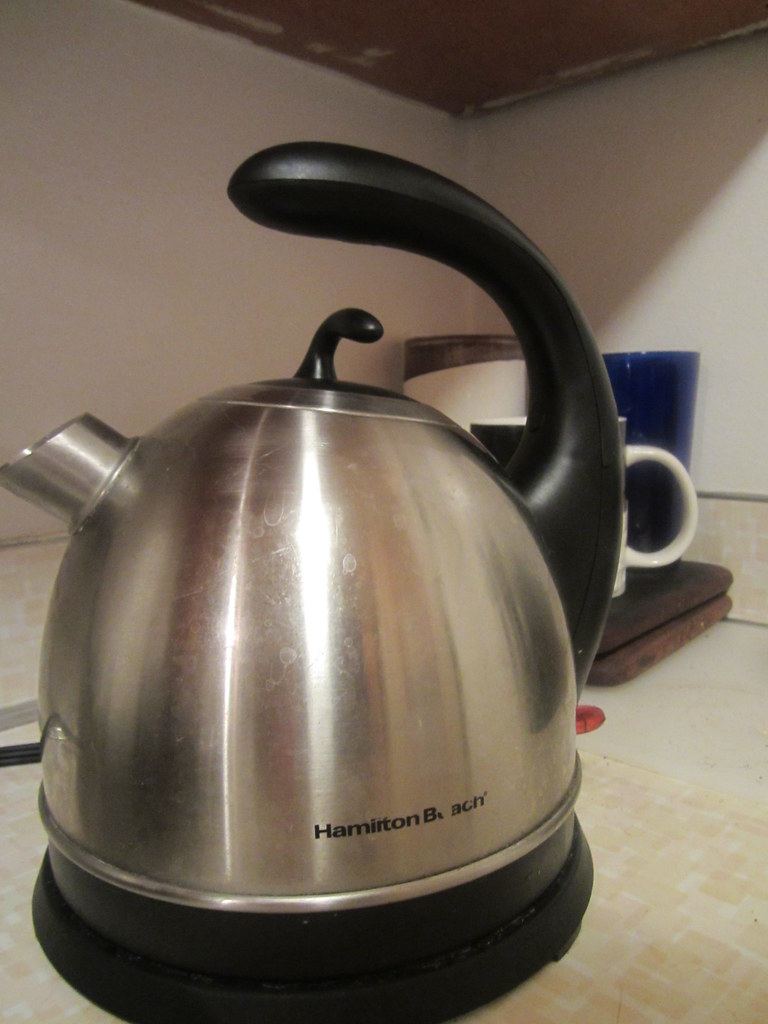
Rosa Whittaker bought a Hamilton Beach 1-litre electric kettle at a Canadian Tire on St. Clair Avenue West in Toronto in May 2018 for thirty-two dollars and change. She has used it every day since.
She is writing about it because she is a tools editor for a small cooking magazine and because she has tested, in the same span of years, eleven other kettles that cost more, performed better on paper, and have all been retired or returned.
The Hamilton Beach is plastic where a more expensive kettle would be stainless. It has a hinged lid that you press a button to open, and the button has loosened slightly in eight years but still works. The base is a plain plastic disc with a single coiled element. There is no temperature control, no keep-warm function, no whistling spout, no chime.
It boils a litre of water in just under four minutes. A Cuisinart she tested in 2019 boiled the same litre in two minutes thirty seconds. A Fellow Stagg EKG she tested in 2021 boiled it in three minutes and looked beautiful while doing it. Neither of those is in her kitchen now.
The Cuisinart developed a leak around the lid hinge in nineteen months. The Stagg, which she liked very much, was replaced by Fellow on warranty after a fault that prevented the temperature setting from holding, and then was given to a friend who lost interest in it within a year.
Her Hamilton Beach has not developed a leak. It has not lost a function, because it did not have many to lose. It has not been replaced.
She is not arguing that cheaper is always better. She has tested four other inexpensive plastic kettles, in the twenty-to-forty-dollar range, and three of them failed within eighteen months. The Hamilton Beach was either a particularly good unit of a mediocre line or a particularly mediocre unit of a good line; she does not know which.
What she knows is that it works. She boils water in it twice a day for tea, occasionally a third time for blanching vegetables or starting a pot of pasta on a hot evening when she does not want to use the stovetop for longer than necessary.
She descales it twice a year with a 50-50 mix of white vinegar and water, brought to a boil and left to sit for an hour. Toronto water is moderately hard. The descaling takes ten minutes including the rinse, and after eight years there is still no significant scale buildup on the element.
She has not dropped it. She has not run it dry, because the safety cutoff has done its job the two times she nearly did. She has not put it in the dishwasher, because the base is electric. None of these are accomplishments; they are baseline.
The kettle has, by her rough count, boiled about 5,800 litres of water over its lifetime. The math is two litres per day for eight years, minus the occasional vacation. At thirty-two dollars, that works out to about half a cent per litre. The water itself costs more.
She is making the cost calculation not to brag about it but to push back against a particular kitchen-tool tendency, which is to assume that an inexpensive small appliance is by definition disposable. Some are. This one is not.
The other side of that tendency is the assumption that an expensive small appliance is by definition long-lasting. Some are. Most, in her testing, are not. The failure modes of a $200 kettle are not meaningfully different from the failure modes of a $30 kettle; the electronics, the hinges, the seals, all wear at roughly the same rate.
What an expensive kettle gives you is design. The Fellow Stagg is beautiful. The Smeg in her test kitchen looks like a piece of midcentury furniture. The All-Clad has a stainless body that develops a kind of brushed-metal patina over time.
She would happily own any of them. She would not, on the evidence of her own testing, expect any of them to outlive the Hamilton Beach on the counter.
The case for variable-temperature kettles is genuine and she does not want to dismiss it. A serious tea drinker who alternates between green, white, oolong, and black teas can use a variable-temperature kettle in a way that meaningfully improves the cup.
She is a black tea drinker who occasionally has a green. She brings the water to a boil for the black, pours some into a small pitcher to cool for the green, and the workflow takes thirty seconds. The variable temperature is, for her, a feature she does not need.
For a household that drinks mostly herbal or mostly green teas, a kettle with temperature control is probably worth the price. She would recommend the Stagg EKG or the OXO Cordless Glass for someone in that situation, with the caveat that both will eventually fail and the failure will be electronic rather than mechanical.
For everyone else, the case for a cheap plastic kettle is stronger than the magazine industry has been willing to make. She is making it here because no one else has, and because she suspects there are readers staring at a forty-dollar plastic kettle at a hardware store this week and wondering whether they should spend more.
They should not, unless the design genuinely matters to them. The hot water comes out the same.
Her Hamilton Beach will eventually fail. When it does, she will buy another one, probably for thirty-five dollars at the same Canadian Tire. She does not expect to mark the occasion.
Filed under