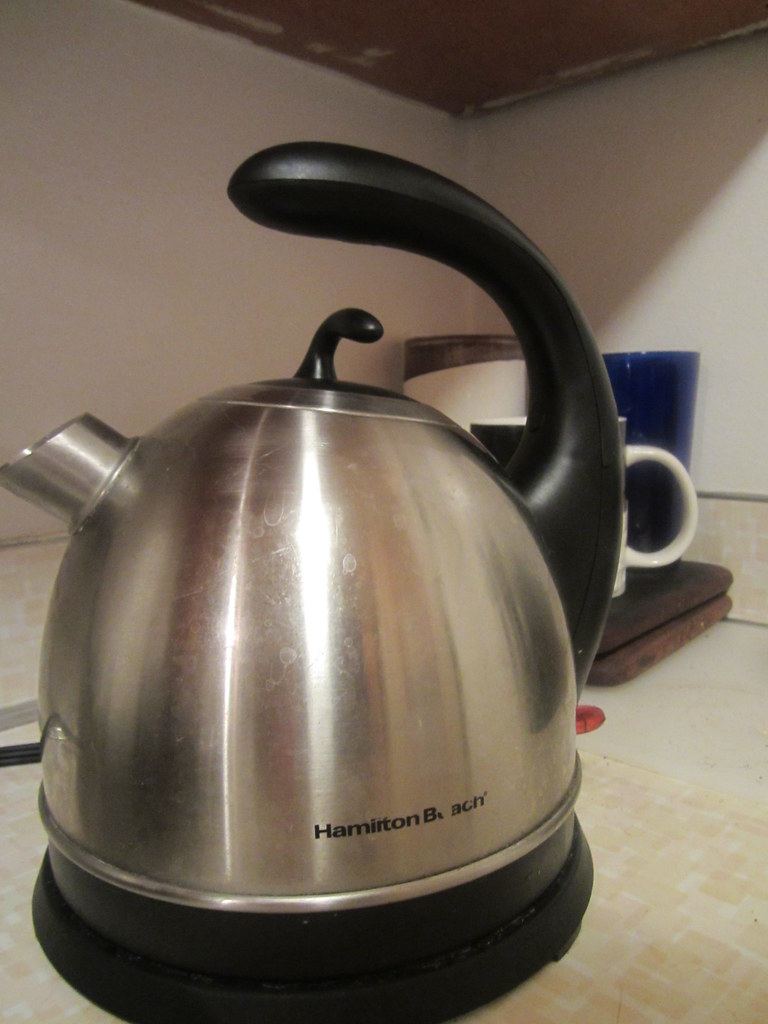
Hyun-Woo Bae fills his kettle at 6:12 every weekday morning. The kettle is a Hario electric model his sister gave him for his fortieth birthday in 2022, and it sits on the counter to the right of the sink in his apartment in the Mapo district of Seoul.
The kettle takes three minutes and forty seconds to boil to 96 degrees, which is the temperature he prefers for his morning sencha. He uses that time to do four small things: open the curtain, feed the cat, rinse the previous night's teapot, and measure four grams of tea leaves into it.
The choreography has not changed in six years. The kettle is, he says, his metronome. The day begins when the water boils.
Hyun-Woo is one of six people this magazine spoke to in the spring of 2026 about the role of the kettle in the structure of a working day. None of them had thought of the kettle as a structuring object before being asked, but all of them, on reflection, agreed that it was.
The cases varied. In Mumbai, a translator named Saira Engineer drinks four cups of strong black chai a day, the first at 6:45, the last at 4:30. Each cup is announced by the small kettle on her gas stove. She does not, she says, set a timer for her work breaks. She sets the kettle.
In Dunedin, New Zealand, a retired civil engineer named Hamish Fairgrieve drinks two cups of plunger coffee in the morning and three cups of tea after lunch. He has owned the same Russell Hobbs kettle since 2008. The kettle has, by his estimate, boiled water about twenty-six thousand times.
In Reykjavik, an oceanographer named Sigrun Halldorsdottir drinks an enormous amount of hot water without anything in it. She fills a 750-milliliter thermos at 8:00 in the morning and refills it after lunch. The kettle is the first thing she touches in her apartment and the last thing she touches in her office.
In Bristol, a cellist named Toby Wakelin has a stovetop kettle from 1979 that belonged to his grandmother. It whistles in F-sharp. He uses it about eight times a day, for tea and for the small pot of oatmeal he makes for lunch.
In Saint John, New Brunswick, a school librarian named Felicity Marsh drinks rooibos in the afternoons because she cannot drink caffeine after noon, and she runs her kettle four times a day at predictable intervals. Her cat, Beatrix, comes into the kitchen at 3:15 every afternoon because she has learned what that kettle sound means.
And in a small village outside Toulouse, a retired schoolteacher named Marcel Lacombe drinks one tisane of dried verbena and lemon balm every evening at 9:00, in a kettle that he says is at least fifty years old. He inherited it from his mother along with the house.
What all six described, in different words, was that the kettle is one of the very few household objects whose use creates a small unit of time that can be relied on. The water takes its three or four minutes to boil. During those minutes, other things can be done, but only small things. The body knows the unit.
Saira Engineer described it as a punctuation mark in her working day. The translation work she does, which involves long unbroken hours of concentration, would, she said, become a single blurred shift if not for the four kettle moments that divide it.
Sigrun Halldorsdottir described it as a kind of permission. The kettle gives her permission to stop working long enough to refill the thermos. Without the kettle, she said, she would not stop.
Hamish Fairgrieve described it more simply as the heart of the kitchen. He said the kettle was the first thing he would replace, if everything in the kitchen were lost in a fire, before the pans or the knives.
What none of them described, notably, was the kettle as a piece of equipment they thought much about. Most of them owned modest kettles. Three were electric, three were stovetop. None of the six had spent more than the equivalent of a hundred US dollars on the kettle they currently used.
The expense was not the point. The repetition was.
Hyun-Woo, asked what he would change about the morning if he could, said nothing. The 6:12 fill, the four small tasks during the boil, the first cup of sencha at 6:18 — these had become, he said, the most reliable pleasure of his life.
There is a small section in Tamar Adler's An Everlasting Meal where she writes about how the kettle is the first appliance a kitchen needs. The piece is brief, almost throwaway. But it stays with you, the way certain Adler sentences do, because it is true.
The kettle does almost nothing. It boils water. It does this with great reliability, on a schedule the cook sets, and it does it for decades. It is the smallest possible kitchen machine, and it is, for many people, the one they touch most often.
On the morning this piece was reported in Seoul, Hyun-Woo's kettle boiled at 6:15, three minutes later than usual, because he had answered an early call from his mother in Busan. The first cup of tea was poured at 6:21. The cat, he said, had not been pleased about the delay.
Filed under