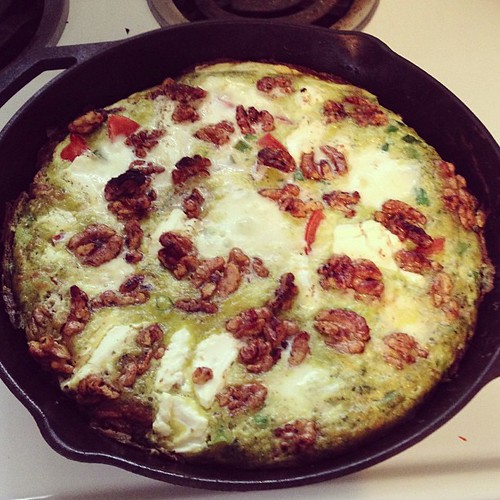
On a Tuesday in mid-May, the day before the Saturday market on Grand Army Plaza will replenish her kitchen, Lou Bertillon stands at the open door of her refrigerator and conducts what she calls the audit.
The audit is a quiet inventory of what is left and what is about to turn. Tonight there are eight eggs in the door — bought a week ago Saturday and still good for at least four more days, by the float test. There is a small wedge of Gruyère, hardened at the cut edge. A quarter of a red onion. Two stems of chard, the leaves bright but small.
There is also a half cup of cold roasted potatoes from Sunday's dinner, which she had forgotten about until she pulled out the chard.
This is, she thinks as she shuts the door, a frittata.
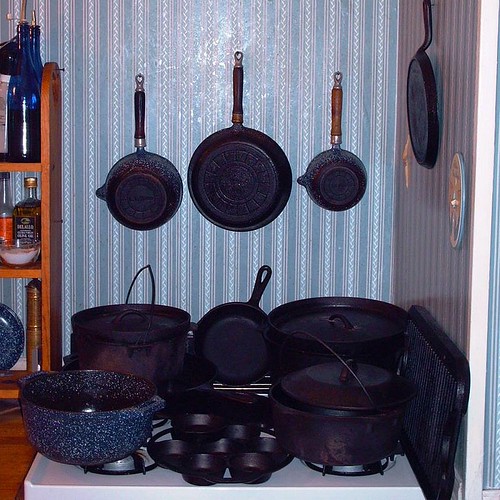
The pan is her 10-inch Lodge cast iron, the one she bought for twenty-two dollars in 2012 when she was still living in a fourth-floor walkup on Henry Street. It is older than her marriage.
She puts the oven on at 200C — about 400F — and sets the cast iron on a medium flame to heat slowly.
The chard gets stripped from its stems, the leaves chiffonaded, the stems diced fine because she does not waste them. The red onion goes into a thin slice. The Gruyère gets grated coarsely on the big holes of her box grater. The potatoes get a rough chop.
Into the warm pan she puts a tablespoon of olive oil and the diced chard stems and the red onion. They cook for four minutes, until the onion is translucent and the chard stems have lost their squeak.
The potatoes go in next and get six minutes alone to crisp at the edges. She does not stir them constantly. She turns them once at the three-minute mark. Cast iron rewards patience.
The chard leaves wilt in last, just thirty seconds, with a small pinch of salt to draw the water out.
Meanwhile, in a glass measuring cup, she has beaten the eight eggs with a fork — not a whisk, a fork — until the yolks and whites are just integrated. A half teaspoon of kosher salt. Twenty grinds of black pepper. A tablespoon of cold water, which she swears makes the frittata more tender.
She pours the eggs into the pan over the vegetables, lets them sit for thirty seconds undisturbed to set the bottom, then uses a silicone spatula to pull the edges in toward the center two or three times, letting the still-liquid eggs run to the edge.
When the surface is mostly set but still glossy in the middle, she scatters the grated Gruyère across the top and slides the pan into the hot oven.
The frittata cooks for nine minutes in the oven, until the center is just set when she shakes the pan and the cheese has gone the color of an old gold ring.
She pulls it out and lets it rest in the pan for five full minutes. This is the hardest part. The frittata will continue to cook in the residual heat, and a frittata served straight from the oven will be wet and slightly broken in the middle.
She slides a thin metal spatula around the edge and under the bottom and turns the whole thing out onto a cutting board. It comes free with a soft sigh of steam.
Cut into six wedges. Two for her, two for her partner, two for tomorrow's lunch.
The frittata, eaten at the small kitchen table with a green salad of whatever lettuce was hanging on in the crisper, is not a virtuoso dish. It is a kind, modest, eight-egg meal that took twenty-three minutes and used what was already there.
She has cooked a frittata on a Tuesday almost every week of her adult life. The vegetables change with the season. The cheese is whatever she has. The eggs are always good eggs. These are the only requirements.
By 7:45 the cast iron is cooling on the back burner and the dishwasher, such as it is, is empty. The audit, conducted properly, ends with an empty crisper drawer and a full table.
There is something old-fashioned about the frittata as a household practice. It does not announce itself. It does not photograph well. It simply takes what is left in the kitchen and turns it into dinner. Which is, most weeks, what a Tuesday is for.
Filed under